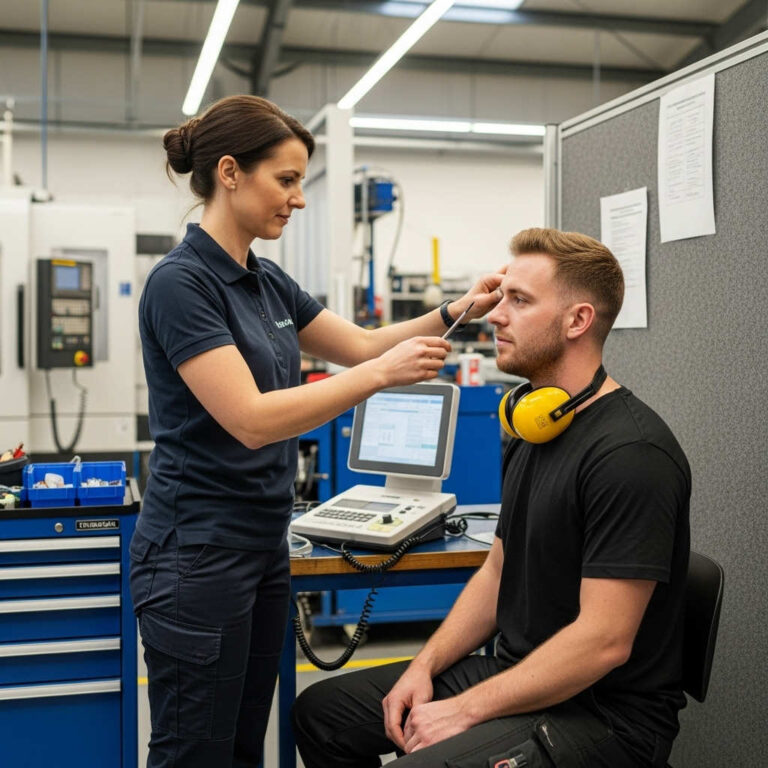
As an HR or H&S Manager in a regulated UK industry, you know the pressure: ensure workforce health, meet compliance, and justify every penny of your Occupational Health (OH) spend.
Are you confident your current health surveillance isn’t leaving your business exposed to severe risks and your employees unprotected?
This guide cuts through the noise to show you how a smart, tailored approach to health surveillance isn’t just a legal necessity – it’s a commercial imperative.
Key Takeaways for Busy Managers
- Non-Compliance Costs Dearly: Overlooking health surveillance invites hefty HSE fines, legal battles, and even personal liability for managers.
- Beyond Fines, Hidden Costs Cripple: Think increased insurance, spiralling absenteeism, lost productivity, and recruitment headaches if your team’s health suffers due to workplace risks.
- Protect Your People, Protect Your Business: Effective surveillance prevents life-altering occupational diseases, safeguarding your most valuable asset – your employees.
- A Tailored Approach is Smart Business: Understanding your specific role-based risks means targeted, efficient health surveillance that delivers compliance and value.
The Unseen Gamble: Why Overlooking Health Surveillance is a Critical Business Oversight
In demanding UK industries like manufacturing, construction, and engineering, the daily pressures are immense.
Yet, treating health surveillance as a line item to be cut, rather than an essential safeguarding process, is a high-stakes gamble.
The Health and Safety Executive (HSE) takes non-compliance very seriously, with conviction rates for health and safety breaches reportedly between 93% and 95%.
Average fines can be crippling for any business.
This isn’t about minor administrative oversights; it’s about fundamental duties of care.
Navigating occupational health regulations can feel complex, and we know the responsibility you carry is significant.
As a SEQOHS (Safe Effective Quality Occupational Health Service) accredited provider, NPH Group believes that a clear, unbiased understanding of all potential risks is the first step.
This knowledge empowers you to protect your people and your business effectively.
One of the core ways we help businesses achieve this is through our detailed role-based evaluation process, ensuring that surveillance is correctly targeted and efficiently delivered.
Risk #1: What are the Legal and Financial Penalties for Non-Compliance?
UK law, primarily the Health and Safety at Work etc. Act 1974 (HSWA) and the Management of Health and Safety at Work Regulations 1999, places a clear duty on employers.
You must assess workplace risks and, where necessary, implement appropriate health surveillance.
For many businesses in manufacturing, construction, and engineering, specific regulations concerning noise (Control of Noise at Work Regulations), hazardous substances (COSHH), vibration (Control of Vibration at Work Regulations), and even night work (Working Time Regulations) further mandate this.
Where do businesses typically fall short legally?
Often, it’s a failure to conduct thorough, role-specific risk assessments, not implementing surveillance tailored to identified hazards (like audiometry for noise-exposed roles or spirometry for those exposed to respiratory sensitisers), or inadequate record-keeping and follow-up on findings.
This isn’t just about ticking boxes; it’s about actively managing risk.
What are the HSE’s enforcement powers if we get it wrong?
The HSE can issue improvement notices (demanding corrective action) or prohibition notices (stopping specific activities).
More severely, they can prosecute.
Fines for breaches are unlimited and can be substantial – average fines were around £150,000 in 2018/19, with some for SMEs exceeding £60,000.
And if the HSE identifies a material breach, they can charge for their investigation time under Fees For Intervention (FFI), which was £163 per hour as of December 2022.
Can managers be held personally liable?
This is a critical point that understandably causes a great deal of concern.
Yes, under Section 37 of the HSWA, if an offence committed by a company is due to the consent, connivance, or neglect of any director, manager, or similar officer, that individual can be prosecuted personally.
This can lead to unlimited personal fines, imprisonment for up to two years, and disqualification from being a director.
The weight of this responsibility is immense.
Consider an engineering firm we learned about.
Due to overlooked surveillance for workers using vibrating tools, an employee developed severe Hand-Arm Vibration Syndrome (HAVS).
The subsequent HSE investigation didn’t just result in hefty company fines; it also scrutinised the H&S Manager’s direct oversight.
It’s a stark reminder of the personal stakes involved when surveillance is inadequate.
A systematic, regular, and appropriate health surveillance programme, informed by a detailed role-based evaluation like ours, is your primary shield.
It demonstrates due diligence, provides robust evidence of compliance, and aligns with recognised standards like SEQOHS, significantly mitigating these legal and personal liability risks.
Risk #2: What are the “Hidden” Financial Burdens Beyond Fines?
While HSE fines are a major concern, the financial fallout from inadequate health surveillance often runs much deeper, creating a cascade of “hidden” costs that can severely impact your bottom line.
These include:
- Rising Insurance Premiums: A poor health and safety record, marked by incidents or HSE actions, inevitably signals higher risk to insurers, leading to increased Employers’ Liability insurance costs.
- The True Cost of Absence (and Presence): Occupational ill health is a primary driver of employee absence. Conditions like musculoskeletal disorders, stress, or occupational asthma mean lost working days – an estimated 35.2 million in Great Britain in 2022/23. Then there’s presenteeism: employees at work but unwell and underperforming, a cost harder to see but very real. The HSE reported 1.8 million UK workers suffering from work-related ill health in 2022/23.
- Spiralling Recruitment & Training Costs: When skilled employees leave prematurely due to preventable occupational ill health, the cost of recruiting and training replacements, especially in specialised sectors like manufacturing or engineering, can be substantial.
- The Threat of Civil Claims: Employees who develop occupational diseases due to employer negligence (like failing to provide or act upon health surveillance) can pursue civil claims for compensation. These payouts can be significant, covering pain, suffering, lost earnings, and medical expenses.
- Operational Disruption & Project Delays: The loss of key personnel, or an HSE prohibition notice halting work, can throw projects into disarray, leading to contractual penalties and lost revenue, particularly damaging in time-sensitive industries. The HSE estimated the annual cost of work-related injury and new ill health cases at a staggering £20.7 billion in 2021/22.
Proactive health surveillance isn’t an expense; it’s an investment in financial stability.
By detecting issues early, it helps reduce absenteeism, maintain productivity, control insurance costs, minimise civil claim risks, and prevent costly operational shutdowns.
Our focus on detailed role-based evaluation ensures this investment is targeted and effective.

Risk #3: What is the Irreversible Human Cost to Your Employees?
Beyond the significant legal and financial ramifications for the business, the most profound and often irreversible impact of inadequate health surveillance is on your employees themselves.
Failing to monitor and protect their health can lead to a range of debilitating occupational diseases.
In sectors like manufacturing, construction, and engineering, common examples include Noise-Induced Hearing Loss (NIHL), Hand-Arm Vibration Syndrome (HAVS) (linked to 300,000 lost UK work days annually), occupational asthma and other respiratory diseases (an estimated 12,000 lung disease deaths annually in the UK are linked to past occupational exposures), occupational dermatitis, and Musculoskeletal Disorders (MSDs).
These conditions often develop insidiously.
An employee might not notice gradual hearing loss until it severely impacts their life and ability to work safely.
A construction worker might dismiss early tingling in their fingers, unaware it’s the onset of HAVS.
The human consequences are severe: chronic pain, disability, loss of livelihood, a significantly reduced quality of life, and even, in some cases, premature mortality.
This is where regular, appropriate health surveillance becomes absolutely essential.
It is not just about compliance; it’s about prevention.
Effective surveillance allows for early detection of the very first signs that an employee’s health might be affected by their work.
This enables prompt intervention – perhaps by reviewing and improving control measures, providing medical advice, or, if necessary, removing the individual from further exposure.
Crucially, it can prevent a minor health issue from developing into a chronic, disabling condition.
It also provides invaluable feedback on whether your existing risk controls are truly working in practice.
Imagine ‘Joe’, a skilled construction worker we know of through our industry experience.
Without regular, role-specific hearing tests as part of a robust health surveillance programme, his gradual hearing loss went unnoticed for too long.
By the time it was severe, it deeply affected his ability to communicate effectively on a busy site, impacting his safety, his job, and even his enjoyment of family life.
This was a preventable outcome.
Our detailed role-based evaluation approach is designed to ensure the right surveillance is done for the right people at the right time, maximising the chances of early detection and protecting your team.
Risk #4: How Can Neglect Lead to Operational Paralysis and Reputational Ruin?
The fallout from health surveillance failures extends beyond direct legal and financial penalties into significant operational and reputational crises.
If the HSE issues a prohibition notice due to serious health risks (like uncontrolled exposure to asbestos or silica dust), work can be halted immediately.
In time-sensitive manufacturing, construction, or engineering projects, such stoppages can mean critical project delays and contractual penalties.
The loss of experienced and skilled employees due to occupational ill health disrupts team cohesion and operational capacity.
Finding and training replacements is a costly and time-consuming process.
Furthermore, companies with a poor reputation for health and safety will inevitably struggle to attract and retain high-quality talent, especially in competitive labour markets where a commitment to worker wellbeing is increasingly a deciding factor for job seekers.
Damage to client relationships is another serious consequence.
Incidents or HSE interventions can erode trust with existing clients, many of whom have their own stringent supply chain requirements regarding health and safety standards.
This can lead to lost contracts and make it harder to secure future work.
And in today’s connected world, negative media attention following serious incidents or prosecutions can have a swift and lasting impact on your company’s brand and public perception.
The cumulative effect is an erosion of trust from all stakeholders – employees, clients, regulators, and the public – creating a distinct competitive disadvantage.
A robust health surveillance programme, as part of a comprehensive health and safety management system, signals to everyone that your company takes its responsibilities seriously.
It minimises operational disruptions by preventing ill health and HSE interventions.
It enhances employee morale and retention by demonstrating genuine care for worker wellbeing.
It strengthens client confidence by providing assurance of responsible operations.
Ultimately, it helps build and protect a positive reputation as a safe and responsible employer.
Our SEQOHS accreditation further underscores this commitment to quality and effectiveness in occupational health service delivery.
Addressing Misconceptions: The Perils of “It Won’t Happen to Us”
We often hear reasons why businesses, particularly SMEs juggling many priorities, might overlook or skimp on health surveillance.
Perhaps phrases like, “It’s too expensive,” “It’s too complicated to set up,” “We’ve never had a problem before,” or “Our Personal Protective Equipment (PPE) is enough” sound familiar.
We understand these pressures.
However, this thinking, while understandable, is risky:
- The True Cost of Inaction: As we’ve seen, the potential costs of not doing surveillance – fines, legal fees, compensation claims, lost productivity, increased insurance, and reputational damage – almost invariably dwarf the investment in a proactive programme. Health surveillance should be viewed as an essential risk management investment.
- Complexity Can Be Managed with Expert Support: Navigating regulations can seem daunting. However, specialist occupational health providers like NPH Group offer expertise in conducting detailed role-based evaluations and managing surveillance programmes efficiently. Our SEQOHS accreditation reflects our capability to deliver effective and quality services, simplifying the process for you.
- Past Luck is Not a Future Guarantee: The absence of a previous incident doesn’t mean risks aren’t present or won’t manifest later. Many occupational diseases develop insidiously over long periods.
- PPE is a Last Line of Defence, Not a Sole Solution: While vital, PPE is not infallible and should be used alongside other control measures. Health surveillance helps verify if all controls, including PPE, are working effectively.
- The Law Applies to All Employers: The Health and Safety at Work etc. Act 1974 and its associated regulations apply to all employers, regardless of size. The HSE even provides specific guidance to help SMEs comply.
As an experienced Occupational Health partner, we believe in empowering businesses with the full picture, even the uncomfortable truths, so you can make the best, most informed decisions.
Is Health Surveillance Really Necessary for My Specific Business?
Perhaps you’re thinking, “We’re a relatively small operation,” or “Our employees are generally healthy, so what’s the point?” or “It seems like an unnecessary expense for our particular industry.”
It’s crucial to understand that legal duties apply to any business, regardless of size, if specific workplace hazards are present that could affect employee health.
In regulated industries like manufacturing, construction, and engineering, such hazards are often inherent to the work.
Many serious occupational illnesses develop gradually and without obvious early symptoms; surveillance is designed precisely to detect these subtle changes before they become major, irreversible problems.
Our goal isn’t to recommend services where they are not genuinely needed, but to ensure you fully understand your obligations and the potential severe consequences of underestimation.
This is about protecting both your business and your people effectively.

Taking Control: Your Path to Mitigating Health Surveillance Risks
We’ve explored the landscape, and it’s clear: failing to implement regular and appropriate health surveillance isn’t a minor oversight.
It’s a significant gamble with potentially devastating consequences for your finances, your operations, your reputation, and, most importantly, your employees’ lives and wellbeing.
The good news is that these risks are largely preventable.
The primary solution is a robust, well-managed health surveillance programme.
Here are key actions you can take:
- Critically Review Your Current Approach: Honestly assess your existing health surveillance programmes (or lack thereof) against the risks we’ve discussed. Are there gaps? Is it truly aligned with your specific workplace hazards?
- Prioritise Thorough Risk Assessments: This is the foundation. Ensure you conduct comprehensive, role-specific risk assessments to accurately identify all employees who require health surveillance and for what specific hazards.
- Champion the Commitment Internally: Use the information about these tangible risks to advocate within your organisation for the necessary resources, budget, and commitment to comprehensive health surveillance. It’s an investment, not just a cost.
Remember, effective health surveillance, tailored to your specific needs, is the cornerstone of preventing these multifaceted risks.
Ultimately, being fully informed about these dangers empowers you.
It allows you to proactively protect not only your business’s legal standing and financial health but, critically, the health, safety, and wellbeing of your valued employees.
Having considered these risks, where does your organisation currently stand in ensuring every team member is adequately protected?
At NPH Group, we believe that open, honest discussion about workplace health challenges is the first step towards creating safer, healthier, and more productive environments.
We remain committed to being a resource you can trust.
Unsure About Your Occupational Health Compliance?
Navigating UK Occupational Health regulations and applying them correctly to your specific job roles can be complex.
Ensuring compliance isn’t just about avoiding fines; it’s about protecting your workforce and maintaining operational efficiency.
Our experienced Occupational Health Specialists are here to provide expert, tailored guidance.
Start with Clarity: Assess Your Compliance Risk
Get access to our our complimentary Occupational Health Compliance Checklist.
This practical self-assessment helps HR & H&S Managers like you identify potential compliance gaps in minutes.
Ready for a clear, bespoke evaluation of your business’s occupational health needs? Access the NPH Group Business Health Evaluation Tool to start your assessment.
Ready for a Tailored Solution?
Once you’ve reviewed your potential needs, or if you prefer direct expert advice, let’s discuss how NPH Group’s detailed role-based evaluation can ensure your business is compliant and your workforce supported.Discuss your specific needs or call us directly on 0191 6053140.
Learn more about our approach to Health Surveillance.Understand the factors influencing Occupational Health service costs